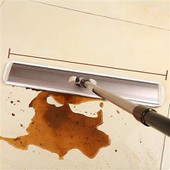
The hands-free mop system is a cleaning device that achieves a closed-loop operation of "squeezing water-mopping-returning water" through its physical structure design. It does not rely on electricity; its core lies in the coordinated action of the pressure rod, water-guiding channels, and flat mop head inside the bucket. When pressed down, the mop head is forcefully squeezed, and water automatically flows back into the bucket along the channels; when lifted, the mop head returns to its original position and remains slightly damp. This mechanical self-cleaning logic originated in Japanese home cleaning innovations as early as the 1980s. After structural optimization, it gradually replaced the traditional wringing action, reducing hand contact with dirt and lowering the risk of repetitive strain injuries to the back. It has also been incorporated into modern home human factors engineering recommendations.
The mop head is made of thickened, high-density fibers, which absorb water quickly and retain it well. It doesn't drip when wet and doesn't lint when dry. After use, hang it on a wall rack to air dry overnight, and it will be as fluffy as new.